Leonardo da Vinci’s 7 Rules for Better Ideas
When people talk about creativity now, they tend to mean brainstorms, moodboards, and the occasional Post-it note arranged with religious conviction.
Leonardo da Vinci had a slightly broader brief.
He painted The Last Supper and Mona Lisa, sketched flying machines centuries before aviation, studied anatomy in forensic detail, and filled notebooks with observations about water, light, motion, plants, weather, and pretty much everything else. He was, in the least overused sense possible, a genius.
But what makes Leonardo interesting isn’t just that he was brilliant. It’s how he thought.
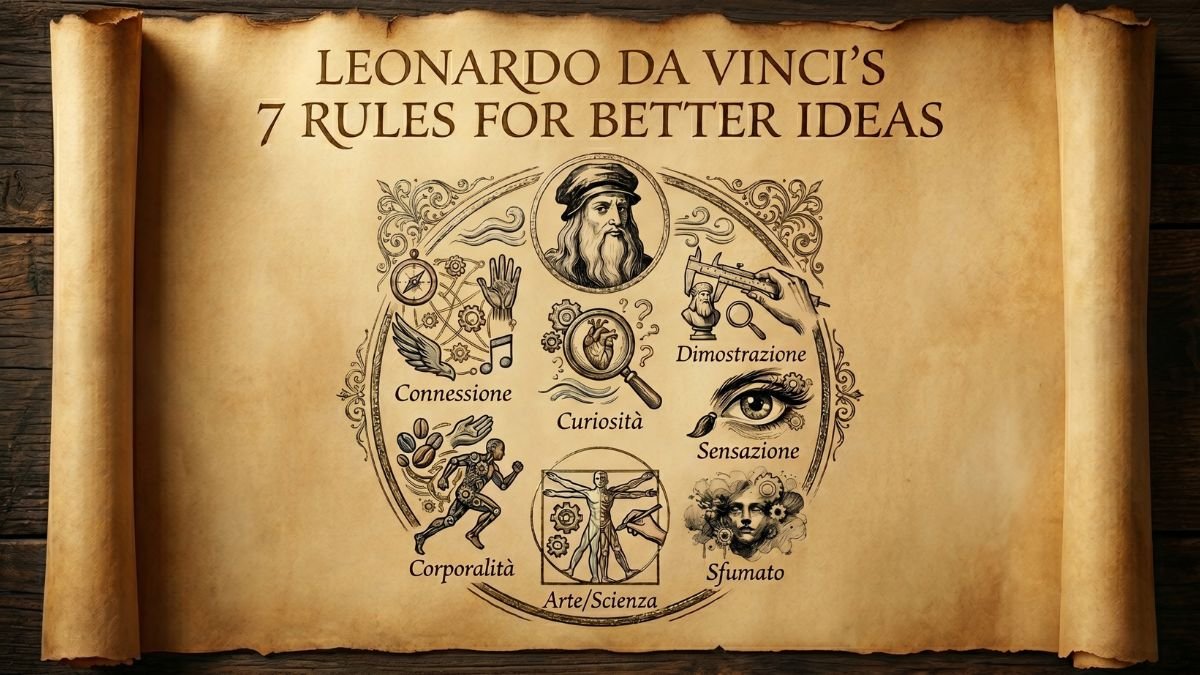
In How to Think Like Leonardo da Vinci, Michael J. Gelb distilled Leonardo’s notebooks into seven principles. And while they emerged from Renaissance Italy rather than a WeWork in Shoreditch, they remain surprisingly useful for anyone whose job depends on original thinking.
Because creativity isn’t magic. It’s not a lightning bolt. It’s usually the by-product of better habits of attention, better questions, and a greater willingness to look slightly unreasonable.
Here are seven lessons from Leonardo that still matter.
1. Curiosità: Be greedier with your curiosity
Leonardo’s curiosity was not casual. It was ravenous.
His notebooks are packed with questions, lists, sketches, observations and prompts to himself. He wanted to know how muscles worked, how birds flew, why water swirled the way it did, how shadows softened at the edges, and what exactly was going on inside the human body. He didn’t have a niche. He had appetites.
This matters because good ideas rarely come from people who are merely informed. They come from people who are genuinely interested.
Curiosity is the engine of creativity. It pushes you beyond the first answer, which is usually either obvious, inherited, or wrong. It gets you underneath the problem. And that is where the useful stuff tends to live.
A lot of modern work rewards speed. Leonardo reminds us that there is still enormous value in fascination.
The best creatives are often just people who stayed interested for longer than everyone else.
2. Dimostrazione: Don’t trust theory until reality has had a go at it
Leonardo was not especially deferential to received wisdom. He preferred evidence to authority, and experience to consensus.
Famously, he dissected human bodies to understand anatomy for himself, rather than relying on what the textbooks of the time claimed. Which is a fairly committed form of fact-checking.
His principle was simple: don’t just believe things because they are widely repeated, elegantly phrased, or spoken by someone in a robe.
That is still excellent advice.
In creative work, people often cling to convention because it feels safe. This is how you get endless campaigns, products, and strategies that look professionally assembled but make no dent in reality whatsoever.
Leonardo’s alternative was to test things. Prototype. Experiment. Observe what actually happens. Be less interested in what sounds right and more interested in what works.
The status quo has a wonderful PR team. Creativity often begins by ignoring it.
3. Sensazione: Notice more than other people can be bothered to
Leonardo trained his senses like instruments.
He studied expressions, posture, movement, texture, light, proportion, atmosphere. He paid attention with unusual intensity. He looked properly, which is rarer than it sounds.
This is one of the least glamorous but most important parts of creativity: attention.
Most people see only what they expect to see. They scan, label, and move on. Creative people often do something else. They pause. They notice a detail that doesn’t fit. They catch a tension, a pattern, a contradiction, a mood in the room, a tiny behaviour everyone else has filtered out.
And those details matter, because better inputs produce better outputs.
A lot of bad thinking is simply the result of low-resolution noticing. Leonardo reminds us that before you can make something original, you usually have to become more observant.
Creativity doesn’t begin with self-expression. It begins with paying attention.
4. Sfumato: Stop demanding certainty from a messy world
In painting, sfumato refers to the soft blurring of edges. In thinking, it means living with ambiguity.
Leonardo understood that the world is not neatly divided into binaries. Many worthwhile problems are unresolved, contradictory, and awkwardly shaped. They do not come with tidy answers and they do not improve because someone insists on simplifying them too early.
This is uncomfortable, which is why most people rush to certainty.
But premature certainty is often just anxiety in a suit.
In creative work, the best ideas usually begin life in a half-formed state. They are incomplete. A bit odd. Slightly difficult to explain without hand gestures. They contain tension. They may even contain contradiction.
That doesn’t mean they are bad ideas. It often means they are alive.
Leonardo’s genius wasn’t just that he had answers. It was that he could sit with complexity for longer than most people. He didn’t panic when things were unclear.
That is a competitive advantage in any creative field.
5. Arte/Scienza: Marry logic and imagination
Leonardo never accepted the modern idea that art and science live in separate houses and should only meet under supervision.
He moved happily between painting and engineering, poetry and mathematics, anatomy and design. He treated analysis and imagination not as opposites, but as collaborators.
Which is a useful correction for the way organisations often split people into tribes: the “creative” ones over here, the “data” ones over there, and the rest trapped in a recurring meeting.
The most interesting ideas usually happen at the intersection of disciplines. That is where one world irritates another into producing something new.
A strategist who understands storytelling has an advantage. A designer who understands behavioural science has an advantage. A marketer who understands architecture, biology or economics has an advantage. Creative range is not decorative. It is practical.
Leonardo reminds us that breadth is not a distraction from original thinking. Very often, it is the source of it.
6. Corporalità: Your brain is not floating in a jar
Leonardo cared about physical vitality. He understood something many modern knowledge workers prefer to ignore: the mind does not operate independently of the body.
Which is mildly inconvenient, because emails would be much easier if solved purely by intellect and a second coffee.
But energy matters. Sleep matters. Movement matters. Mood matters. The quality of your ideas is shaped by your physical state more than your calendar suggests.
This is not an argument for becoming a Renaissance athlete. It is simply a reminder that creative performance is biological as well as mental.
When we are exhausted, overstimulated, sedentary, and staring at six tabs plus Slack plus a phone, we tend not to produce our finest thinking. We produce admin with branding.
Leonardo’s point is that sustained creativity requires stewardship. You do not just need talent. You need the conditions that allow talent to function.
7. Connessione: Join the dots other people keep in separate boxes
Perhaps the most Leonardo-like habit of all was his ability to see connections.
He noticed that the movement of water, air, and blood shared patterns. He observed links between anatomy and mechanics, between nature and design, between structure and beauty. He understood that reality is less compartmentalised than our job titles suggest.
This sits at the heart of creativity.
Original ideas often come not from inventing something from scratch, but from combining existing things in a surprising way. A principle from biology applied to branding. A lesson from architecture used in product design. A pattern from nature borrowed for business.
In other words: innovation is frequently the art of theft with taste.
The people who generate the most interesting ideas are often the ones who read widely, notice patterns, and resist the urge to keep knowledge in neatly labelled drawers.
Leonardo saw everything as connected. That mindset still matters, because the best ideas usually come from unexpected combinations.
So what’s the real lesson?
Leonardo’s seven principles still resonate because they reveal something reassuring about creativity.
It is not just a gift bestowed on a lucky few in flattering portraits.
It is a way of thinking.
It is how you pay attention.
How you question.
How you test.
How you tolerate uncertainty.
How you draw from different disciplines.
How you look after your energy.
And how readily you spot links between things other people assume have nothing to do with each other.
That, ultimately, is what shapes the quality of your ideas.
In an age addicted to speed, certainty, and hot takes, Leonardo offers a more useful model: be curious, be observant, be experimental, and stay open longer.
Not a bad standard for creative work.
Want to sharpen your creative thinking? Check out our marvellous Creative Thinking course.