Why You Should Brag About Your Failures
Let’s be honest, most marketing advice is boring. It’s usually some variation of "be authentic" or "post more on LinkedIn."
But what if I told you that the secret to selling more stuff involves heavy spoons, loud crisps, and admitting that you failed over 5,000 times?
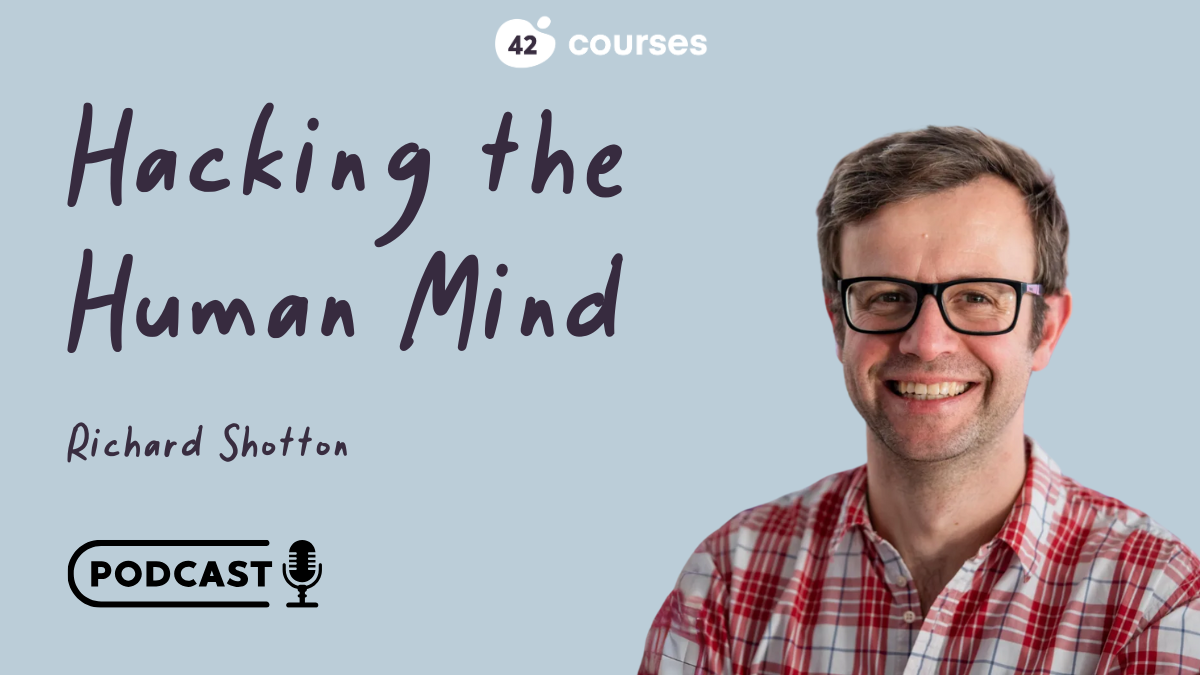
In this week’s episode of the 42courses podcast, we sat down with the behavioural science legend that is Sir Lord Captain Richard Shotton (okay, we added the titles, but he deserves them). Richard is the author of The Choice Factory and his brilliant new book, Hacking the Human Mind.
Unlike his previous books, where he starts with the science, this time he flips the script: he looks at the world's biggest brands (Amazon, Facebook, Dyson) and reverse-engineers the psychology that makes them print money.
Here are four mind-bending takeaways from our chat that will change how you sell, write, and eat Pringles.
1. The "Locksmith Paradox": Why We Hate Efficiency
Imagine you lock yourself out of your house (we’ve all been there). You call a locksmith.
Scenario A: He sweats, grunts, and struggles with the door for 45 minutes. He charges you £100. You happily pay him and offer a tip.
Scenario B: He walks up, picks the lock in 10 seconds, and charges you £100. You feel ripped off.
Why? Because of something called the Illusion of Effort.
As Richard explains, we have a warped moral compass when it comes to value. We don't just judge a product by the result; we judge it by the sweat equity that went into it. If it looks easy, we assume it’s cheap, even if the "easy" version is actually better for us.
The Fix? Show Your Work. Dyson is the master of this. James Dyson’s autobiography literally opens with the line: "I went through 5,127 prototypes before I got to the bagless vacuum". By highlighting the struggle, he justifies the premium price tag.
Don’t hide the magic. If your team spent 350 combined years learning how to make that slide deck, put that on the slide deck!
2. The "Curse of Knowledge" (Or, Why Your Emails Suck)
Have you ever explained something perfectly clearly, only to have the other person stare at you like you’re speaking Elvish?
You are suffering from the Curse of Knowledge.
Richard tells the story of a 1990s Stanford study by Elizabeth Newton involving "Tappers" and "Listeners." The Tappers were asked to tap out the rhythm of a famous song (like "Happy Birthday") on a table. They predicted 50% of people would guess the song. The reality? Only 2.5% got it right.
Why: When you are tapping, you hear the full orchestra in your head. The listener just hears erratic banging.
The Fix: You are the Tapper. Your customers are the Listeners. You have the backstory, the context, and the jargon in your head. They don't. Stop assuming they can hear the music. Spell it out for them.
3. Gastrophysics: Why Heavy Spoons Taste Better
This is where it gets weird. Oxford psychologist Charles Spence has proven that our senses, touch, sound, and sight, change how food tastes.
The Cutlery Hack: In one study, people rated food significantly higher quality (and were willing to pay more) simply because they were eating with heavier cutlery.
Why?: Pringles aren’t just shaped that way for stacking. Spence found that if you amplify the "crunch" sound in headphones while someone eats a chip, they perceive it as fresher. If you mute the crunch, they think it’s stale.
The Fix: If you're selling a premium product, don't put it in a flimsy wrapper. The weight, the sound, and the texture are part of the price tag.
4. The AI Trap: Keep the Robot in the Closet
We all love AI. It makes us faster and smarter. But according to Richard, you should maybe keep your usage on the down-low.
He cites a 2023 study by Kobi Millet, where people were shown two identical posters:
Labelled "Hand Drawn"
Labelled "Created by AI"
The purchase intent for the AI version dropped by 61%.
Why? Back to the Illusion of Effort. We know tools like ChatGPT are fast. And because we equate "fast" with "low effort," we assume the quality is lower.
The Fix: Use AI to do the work, sure. But maybe don't put "Proudly Made by a Robot" on the packaging just yet.
So whether you’re selling vacuums, soup, or software, the product is only half the battle. The story you wrap around it, the effort, the sensory details, and the clarity are what actually open people’s wallets.
Want more?
Listen: Catch the full episode of Richard’s 42courses podcast for 35 minutes of pure gold.
Read: Grab Richard’s new book, Hacking the Human Mind. It’s witty, practical, and fully transparent about the effort that went into it.
Take the course: Richard made a marvellous Behavioural Science for Brands course with us, it’s all about how to use behavioural science to help you grow your brand and sell more.